first-gen. then a decade running financial aid at three bay area colleges.
I was a first-generation college student, so I learned how to navigate college mostly on my own, with very little support. Then I spent a decade in higher education — running financial aid at three Bay Area colleges. I watched students make one of the most consequential decisions of their lives with bad information, enormous pressure, and tools that weren't built for them. College search felt like it was designed for institutions, not students.
When I started building with AI seriously, this was the problem I kept coming back to. Not because it's a big market — because I actually know what it feels like to sit across from a student who chose the wrong school and is now buried in debt they didn't expect. Admyt is the tool I wish had existed then.
The brand tagline is "Find where you fit." The brand signature is "The y is for you." Both are deliberate — this is supposed to feel like it's on the student's side, not the institution's.
Why Build Admyt
Most college search tools are built around what institutions want to show off: rankings, selectivity, and prestige. That isn't what students are weighing. Today's college seekers want to know what college will cost, what it will lead to, whether they can trust what they're reading, and who can help them through it.
The research backs that up:
every number here was checked against its primary source.
Cost comes first. 47% of college-bound high school students, and 54% of college-bound seniors, say cost is the most important factor in where or how they pursue higher education. (Fidelity, 2025 ↗)
Value means a real future. Their top goals are a job in a field they care about (65%), earning enough to support their long-term goals (61%), and a stable career (61%). (Fidelity, 2025 ↗)
Good information is hard to find. 68% of young people aged 16 to 22 say it is difficult to find unbiased information about colleges. (NACAC, 2023 ↗)
Too many go it alone. 59% of those who applied wish they had more support with their applications, and they feel most comfortable asking parents, family, and peers for help. (NACAC, 2023 ↗)
Students want control. 45% of college-bound students like sites that let them filter and personalize what they see. Only 16% expect sites to personalize for them automatically. (RNL E-Expectations, 2025 ↗)
Trust has to be earned. 35% of teens say they have been misled by fake content online, and 74% say privacy safeguards and transparency are important for AI. (Common Sense Media, 2025 ↗)
That's the gap admyt is built for. Fit over prestige. Plain-language answers about paying for college, with official sources and dates students can check. Evidence about support, outcomes, and belonging instead of rankings. And a student who stays in control of their own search, including who comes along for it.
How Sib Backs Up Its Claims
3,881 colleges. 650+ with facts from their own websites.
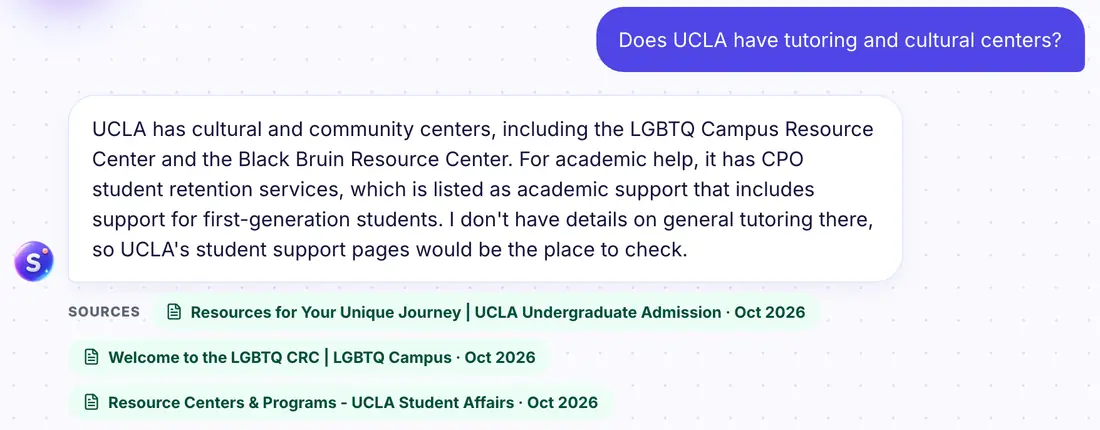
Every claim Sib makes should be something a student can check. So admyt starts with federal data for all 3,881 colleges in the catalog, from the College Scorecard and IPEDS. On top of that, more than 650 schools now have school-specific facts researched from their own official websites: cultural and community centers, affinity groups, faith communities, tutoring, and more. Each fact carries its source page and the date it was checked, and each one was reviewed before Sib could use it. Sib looks them up when a school comes up and cites them in chat with links back to the source, and more schools are on the way.
A real answer, captured just before Sage became Sib: three official UCLA sources, each dated, and a plain "I don't have details" where it doesn't know.
What I Built
renamed from sage on oct 13, the day it became an agent.
guest-first. most students explore before signing up.
Sib — an AI guide with a warm, older-sibling personality, built on the Claude API as an agent: it looks schools and facts up as it needs them, cites its sources, offers to save a school or add a task to Your Plan, and remembers what a student tells it, narrowly and visibly. Persistent chat, inline school cards with a heart mechanic, and, for signed-in students, awareness of their own plan
Vibe Check — a nine-dimension culture-fit read. Students drag the parts of campus life that matter into a "vibe box" (tap and keyboard work too), and Sib gives the honest read
Perspectives — current and former students share what their school actually felt like: six vibe scales, four story prompts, human review, and separate consent for publishing and AI use
Your chosen support — students invite up to two people who are actually in their corner: a parent, grandparent, coach, or mentor, their choice. Nothing is shared until the student turns it on; supporters can cheer, help with handed-off tasks, and suggest schools, but never see the Sib chat
Your Plan — a weekly application plan with deadlines, campus visits, and student/supporter tasks, plus four checklists and three worksheets for comparing schools, reflecting on visits, and getting ready to enroll
Guides — 43 plain-language answers on paying for college, applying, choosing, visits, enrolling, and transferring in California, each linked to its official source and checked date. Sib answers from the same guides in chat
College search and browse — filters across 3,881 real colleges from the College Scorecard API
Teen safety and privacy — scope rules for a 13–17 audience, a three-layer crisis response (988, Crisis Text Line, 911), abuse protection, and consent at sign-up
Observability and evals — Langfuse tracing with privacy masking, plus a 20-scenario Sib eval baseline graded by human review
The vibe-board design — a light, journal-like design system across every screen, hand-written CSS, reduced-motion support throughout
Auth — guest-first, with optional passwordless email codes, Google, and Apple. Most students explore before signing up
What I Learned
for teens, the crisis flow is the product.
System prompt design is a product skill
Getting Sib to feel like a warm older sibling — not a chatbot — required more iteration on the system prompt than on the UI. Tone is a product decision, not a writing decision.
Guest-first auth changes everything
Requiring signup before exploring killed early engagement. Switching to guest-first with optional auth late in the flow was the right call — and it's a pattern I'd use again.
Lazy persistence is worth the complexity
Generating and caching AI descriptions on first request — rather than upfront for every college — cut costs significantly without hurting the user experience.
Safety is a product requirement, not a disclaimer
For an audience of teenagers, the crisis flow, the scope rules, and the privacy filter are as much "the product" as the vibe box. Connecting to an AI API is easy; teaching an agent your topic while keeping users safe is the actual work.
You can't improve what you can't see
Langfuse tracing turned vague doubts about Sib into specific findings — like Sib making claims its data doesn't support. Evals need a human reviewer before they need an AI judge.
Where It's Going
perspectives in sib: built, still switched off.
NOWReview the first student perspectives, then show approved ones on school pages and in Sib and Vibe Check (built, still switched off)
NOWHuman review of the first Sib eval baseline, fix the grounding issues it surfaced, then rerun the same cases to measure the change
NOWFull release to students beyond my personal network, with advertising and marketing campaigns
NEXTTurn de-identified real conversations into new eval cases, carefully
NEXTAdd more data sources so Sib has the most accurate information to help college seekers
LATERA Vibe Check for choosing between acceptances