- Perspectives is live. Current and former college students can share what their school actually felt like, at any of the 3,881 schools in admyt. No account needed.
- Six vibe scales and four story prompts, built around the same parts of campus life Vibe Check looks at. There's no overall score.
- A person reviews every submission before anything goes public, with tools for trimming details that could identify someone.
- Two separate permissions: one to publish on admyt, and an optional one to let Sage learn from it.
- Next: approved perspectives on school pages, in Sage, and in Vibe Check. That part is built and still switched off while I review what it produces.
The gap data can't fill
In my last post I wrote about giving Sage a real knowledge base: more than 135,000 checked data points across 3,881 colleges. Sage can now tell you how many undergrads a school has, its graduation rates, and whether it offers childcare or undergraduate research.
What it can't tell you is what a Tuesday night feels like. Whether Greek life is everything or easy to skip. Whether you'd find your people in your first month or your third year.
That gap showed up in my evals too. The failure I kept catching was Sage filling it with confident guesses, like calling a campus "supportive and collaborative" with nothing behind it. So Sage has a firm rule now: no invented student testimony. The fix isn't to make Sage guess better. It's to ask the people who were actually there.
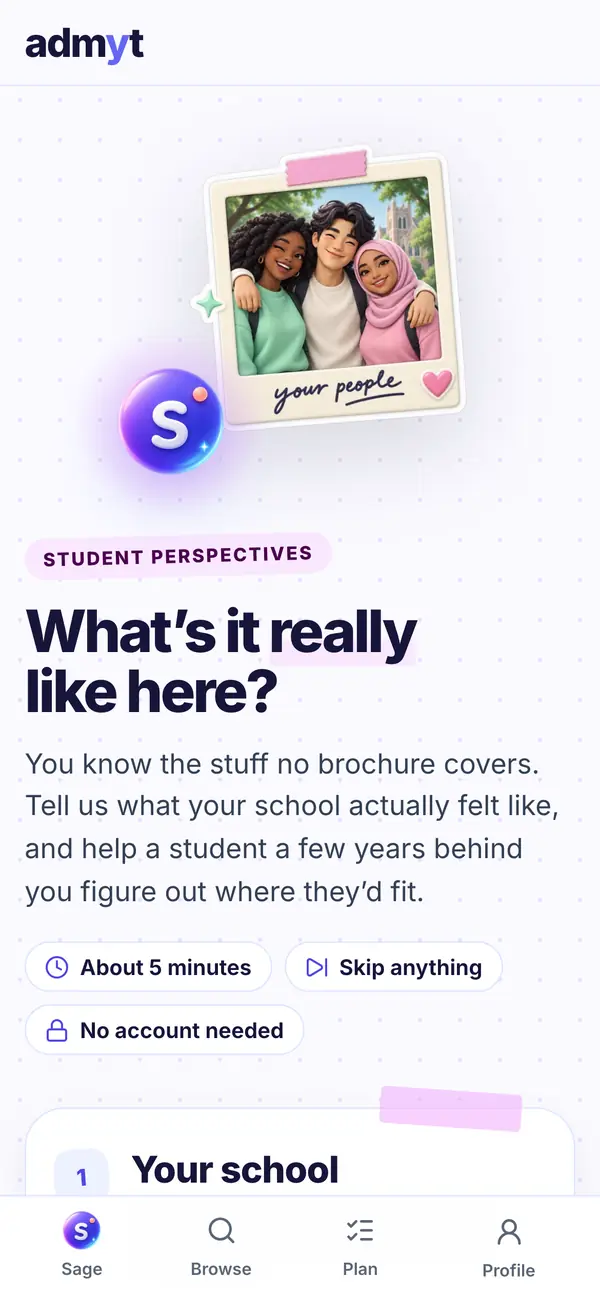
The page says it better than I can:
These are the questions students ask Sage at 1am. Your answer is the closest thing they'll get to asking you.
What you share
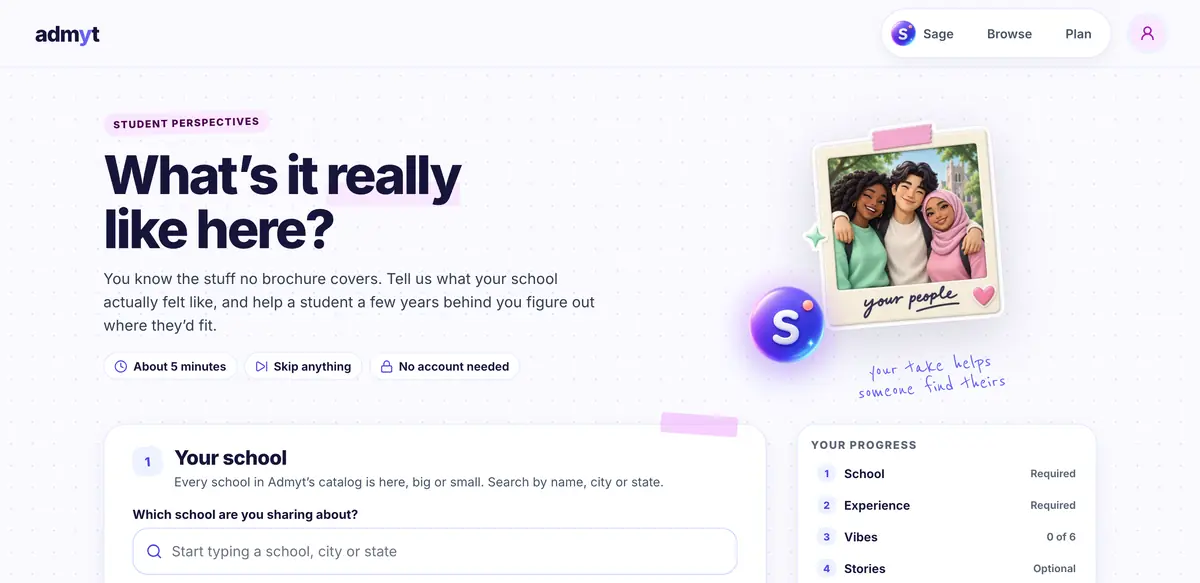
It takes about five minutes, in five short steps:
- Your school. Every school in the catalog, big or small, searchable by name, city, or state. Popular schools get no ranking boost.
- Your experience. Current or former student, the years you attended, and optionally your major and how you lived.
- Your vibes. Six parts of campus life.
- Your story. Four optional prompts. One answer is plenty.
- Review and share. A live preview shows exactly what other students will see.
Six vibes, not a score
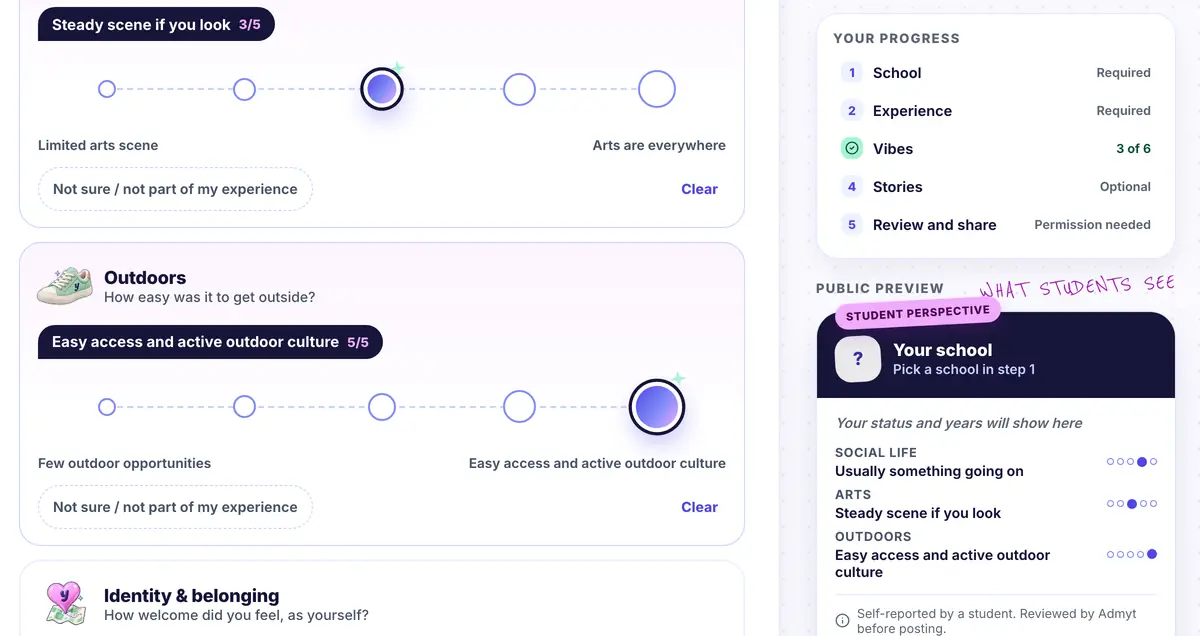
The six scales match the parts of campus life Vibe Check researches:
Every mark on every scale has words, not just a number. Arts runs from "Limited arts scene" to "Arts are everywhere", with "Steady scene if you look" in the middle. Every scale also has a "Not sure / not part of my experience" option. All of them start unanswered, and they never add up to an overall rating.
My favorite line on the page is right above the scales:
A 5 isn't better than a 1. Someone looking for a quiet campus wants to hear about the 1s.
That's the whole admyt thesis in two sentences. Fit matters more than rank, so no end of a scale is the "good" end.
Four questions students actually ask
- What surprised you after enrolling?
- How easy was it to find your people?
- What do you wish you'd known before choosing this school?
- Who do you think would thrive here, and who might struggle?
Each is optional and tucked into its own card. The only rule is that you share at least one vibe or one story.
Identity and belonging, handled carefully
The hardest scale to design asks "How welcome did you feel, as yourself?" It's also the one that matters most for a lot of students. So the page says plainly that it's about your own experience, and that you don't need to tell us who you are or which communities you're part of. Any context you add can be marked private, and reviewers see it labeled "Private: reviewers only, never publish."
Privacy by design, again
Perspectives is the first part of admyt where people other than the student write the content, which made the privacy and consent work even more important:
- You see exactly what goes public. The live preview shows your vibes and stories, never your name or email, and labels it "Self-reported", never "verified".
- Two separate permissions, both unchecked. Publishing on admyt is required to submit. Letting Sage use your perspective in AI summaries and Vibe Checks is optional, and you can publish without it.
- No account, so abuse protection does the work. Daily limits per connection and per email (stored only as hashes), a daily cap overall, a hidden spam trap, and an off switch if a spam wave hits.
- Logs record that a perspective arrived, never what it said. Declined submissions are deleted automatically 90 days after review.
A person reads every one
Nothing goes live without review. The review queue lives in admyt's admin tools, behind the same server-side allowlist as everything else there:
- Waiting, approved, and declined tabs, oldest first, with a flag when anything has waited more than a week.
- Warnings for text that looks like an email address, phone number, link, or @handle.
- Trimming tools to remove identifying details. Reviewers only remove words, never add them.
- Contact details stay hidden unless a reviewer reveals them for one submission, and every reveal, decision, and edit goes into an audit log that never stores the submission text.
- Delete on request, with a confirmation step.
Approving a submission still doesn't publish it. I built the review tool before the publish button on purpose.
What's next: closing the loop
The next piece shows approved perspectives on school pages and gives Sage and Vibe Check the ones students allowed AI to use. It's built and tested, and it stays switched off until I've read enough fresh answers to trust it. The guardrails I care most about:
- A student's words are evidence, not instructions. If someone hides a command in their story, Sage ignores it.
- Sage links every perspective it uses, so a student can read the original in context.
- One story can only nudge a Vibe Check. A single recent perspective can move a score by at most one point. Two points requires agreeing ratings plus matching research, and older or uncited perspectives can't move scores at all.
- Changing your mind works. On request, a reviewer can withdraw AI permission and Sage stops using that perspective in new answers, or delete it entirely.
A 20-call simulation of that connection has already caught two bugs before any student saw them. That's the eval habit paying off again.
What I learned
Help a student find their fit
If you're in college now, or graduated in the last few years, you know the stuff no brochure covers. Five minutes of your honest take could help someone choose a place where they'll actually belong.
Previous: Rebuilt before launch →Back to the admyt case study →